
Corporates
- Protect payments, client data and reputation.
- Support your security duties under POPIA.
- Get session reports your risk committee can read.
Armourware™ is a cybersecurity awareness company. Our facilitators train people at every level, from the front desk to the boardroom, to check a request before they act on it.
When a pangolin senses danger, it stops and curls up to protect what matters.
That pause is the behaviour we train. The scales are the armour. The core is the person inside it, who checks before they act.
R1.4bn
64,000
65.3%
SABRIC’s finding: these weren’t hacks of bank systems. They came from “social engineering techniques that exploited human error.”
Every one of those began with a person being asked to do something. That’s where awareness works.
Five channels, one kind of request: move money, share data, or open a door. None of it needs a hacker to break anything. It needs someone to say yes.
Accounts · your usual supplier
to me · 08:12
Updated banking details for this month’s invoices
Good day. Please note our banking details have changed. Kindly update your records and use the attached details for today’s payment, as our old account is now closed.
Fake invoices and login pages
+27 94 812 3307
online
Hi, it’s your MD. New number, my phone was stolen.
Need a favour before 12. Can you buy four R1,000 gift vouchers for the client event? I’ll pay you back today.
Send me the codes here. In a meeting, can’t talk.
A “manager” writing from a new number
Text message · Today 07:41
Parcel desk
Your parcel is on hold at the depot. Pay the R24.50 delivery fee by 17:00 to release it: parcel-release•••/pay
SMS
Bank and delivery alerts with a link
Voice message · +27 95 330 1862
“Hi, it’s Karen from finance. The auditors need the supplier payment released before three. I’ve approved it, just process it please, I’m driving…”
Voice note
A cloned voice asking for money

Video call
A deepfake face in a live meeting
SABRIC has already seen voice deepfakes impersonating people and bank officials.
It warns that real-time deepfake audio and video may become a common fraud tool. Spotting the fake is not the skill. Checking is.
The A.W.A.R.E protocol is five steps anyone can remember, and the behaviour every programme teaches. Here it is on one message.
+27 94 812 3307
online
Anton
CEO · mobile · from your contacts
calling…
IT security desk
Usually replies within minutes
Anton (CEO)
last seen today at 10:04
Assess.
What is this asking me to do?
Name the ask: money, data, access or a secret.
Wait.
Whose clock am I on?
Don’t act at their speed or inside their channel. Urgency is the scammer’s tool.
Ask.
Check on a channel you choose.
Never a number or link from the message. A cloned voice can’t answer a call-back on a number you already have.
Report.
Tell the right people within minutes.
Especially if you already acted. People who report fast are the best alarm an organisation has.
Expect.
Invite others to check you.
When you ask for money, data or access, tell people to call you back. There will be a next one.
“I’ll call you back on your usual number. It’s our A.W.A.R.E rule.”
Our own facilitators run every session, on site or online. Each module is built from twenty-minute scenario rounds, and every round has a fake request and a genuine one.

One round, twenty minutes.
Decide
Everyone votes privately: genuine or fake?
Defend
Two people argue opposite calls. Then the reveal.
Practise
Someone makes the call-back out loud while the facilitator pushes back.
Debrief
Which letter broke? One rule to keep.
No blame. Votes are anonymous, and nobody is named or scored. Safe to be wrong. Mistakes in the room prevent mistakes at work. Stories stay. What people share stays in the room; the lessons leave with them. Your world. Your month-end, your systems, your local cases.
Each package has a fixed time and a clear audience. Combine them, and start with your leaders.
Everyone in the organisation
The A.W.A.R.E protocol and six scenario rounds on the attacks people see every week.
Shield Site: 90 minutes for frontline and shift workers, in the home language.
The people whose hands move money, data and access
The protocol, two rounds, then a role lab with a live simulation of their own process.
Two streams: Up to two role streams can run in one day.
Executives, boards and senior officials
Seven leadership modules, including a crisis tabletop and a media call.
Board Briefing: Two hours, inside your board meeting. Commitments go into the minutes.
The whole organisation, top to bottom
Helm, Gauntlet and Shield together, measured before and after.
Measured: A baseline, a 90-day re-check and a page for your board.
Packages can be combined. We recommend leaders go first.
Compare the packages
In one study, phishing awareness held four months after training and was gone by six. So the habit gets reinforced after the room empties.
A setup call
We collect your real numbers, processes and dates, so the scenarios look like your week.
A wallet card
The rule, plus your IT, fraud line and Information Officer numbers. For everyone.
Three nudges
About four minutes each, by email or opt-in WhatsApp.
A session report
How the room decided, the themes, and the process gaps we found.
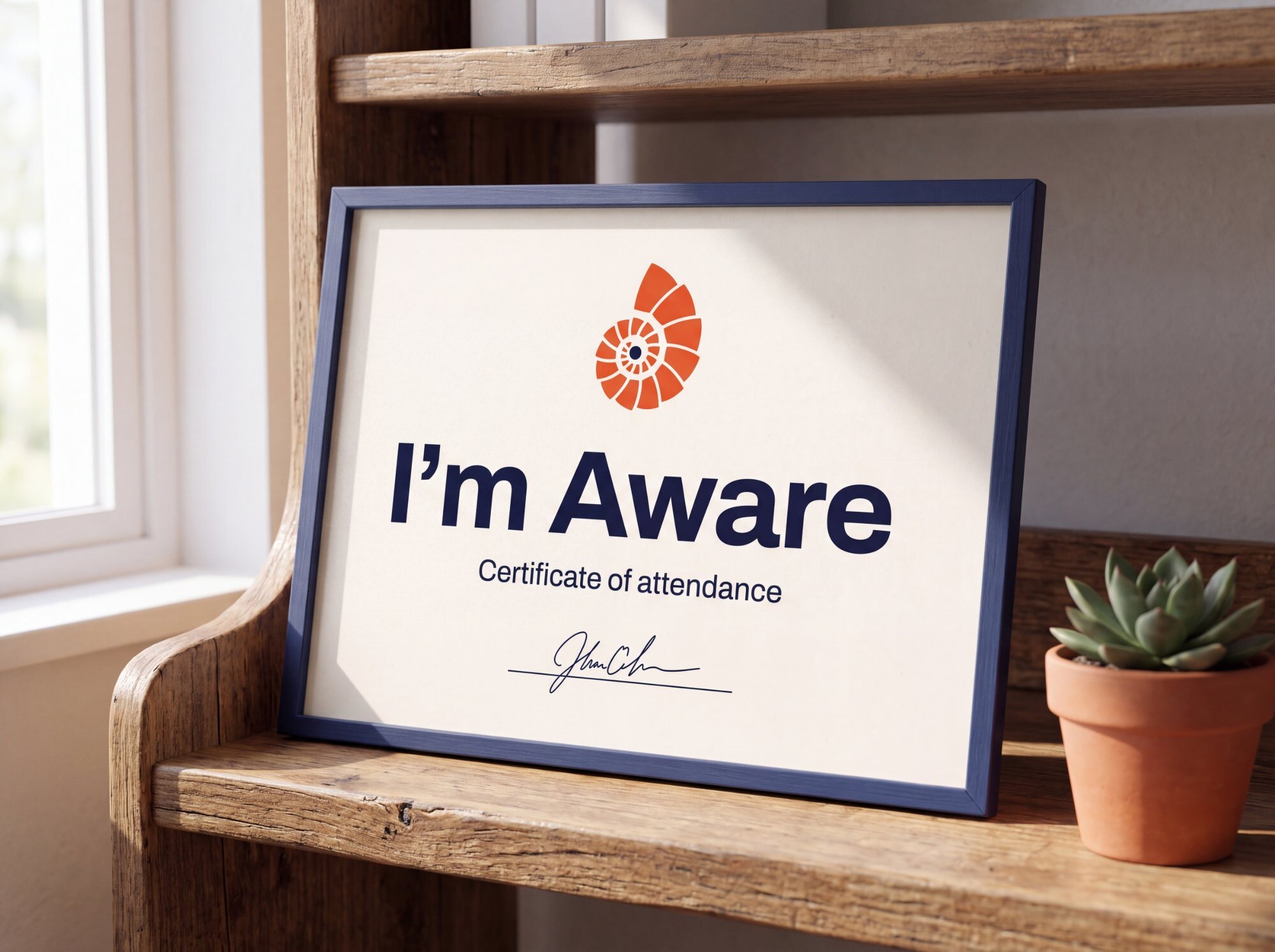
I’m Aware.
Everyone who attends a full session receives the I’m Aware certificate of attendance, and you get a register of who has been trained and who hasn’t. Teams that hit their targets become I’m Aware certified.
It records attendance. It isn’t an accreditation or a qualification.
Start with a setup call. We’ll recommend the package that fits your risk, and set dates away from month-end and payroll. Our advice: start with Helm or the Board Briefing, so your leaders go first.
